Technical Resources
When should a steel mill choose a telescopic rather than a fixed-length cardan shaft?
Compare telescopic and fixed-length cardan shafts for steel mills in India. Check working travel, roll changes, installation space and maintenance.
A steel mill should choose a telescopic cardan shaft when the required connection distance changes while the drive remains connected, or when an approved installation or roll-change procedure needs length adjustment within the shaft itself. A fixed-length, non-telescopic cardan shaft can be considered when the working distance is controlled, any necessary axial movement is accommodated elsewhere, and installation and removal remain practical. Confirm both options against torque, speed, joint angles and the actual mill layout.
The deciding question is not simply whether the application is a steel mill. It is where, when and by how much the connected geometry must change.
Telescopic and fixed-length cardan shafts: the practical difference
Both arrangements use universal joints to transmit torque between shafts operating at an angle. A non-telescopic cardan shaft is therefore not the same thing as a rigid coupling. Its distinguishing feature is the absence of a designed telescopic length-compensation section in the assembly.
| Selection question | Telescopic arrangement | Fixed-length arrangement |
|---|---|---|
| Does the required connection distance vary during connected operation? | A candidate if its permitted working range and sliding conditions cover that movement | Requires the complete installation to accommodate the movement elsewhere |
| Is shortening needed for a roll change? | May support the approved removal procedure, subject to support, engagement and travel limits | Can remain suitable if another approved dismantling or removal method is available |
| Is there angular misalignment? | Check both joints, phasing and the speed–angle conditions | The universal joints still require the same geometry review |
| Is the working span stable? | Can be assessed, but additional travel may not be needed | A candidate if the operating geometry and assembly requirements are satisfied |
| Are scale, water and maintenance access important? | Confirm protection and servicing of the sliding section and joints | Confirm joint servicing, connections and access; non-telescopic does not mean maintenance-free |
“Welded”, “flanged” and “telescopic” describe different aspects of a shaft. A welded configuration can include length compensation. Use the specific drawing rather than inferring the movement capability from one word in a product name.
1. Choose telescopic when the connected working distance varies
Start with a layout showing the gearbox output, the driven roll or machine axis, both joints and the connection reference planes. Record the equipment positions used during production and adjustment.
Roll-gap adjustment, changes in roll position or other machine movements may alter the required connection distance. The effect depends on the actual layout: an adjustment does not create the same length change in every mill stand. Determine the distance and joint angles at the relevant positions rather than choosing telescopic construction from the equipment name alone.
A telescopic shaft is a candidate when that distance change must be accommodated within the shaft while it remains connected. Confirm whether the movement occurs while rotating, under transmitted torque, or only while stopped. Those are different operating conditions for technical review.
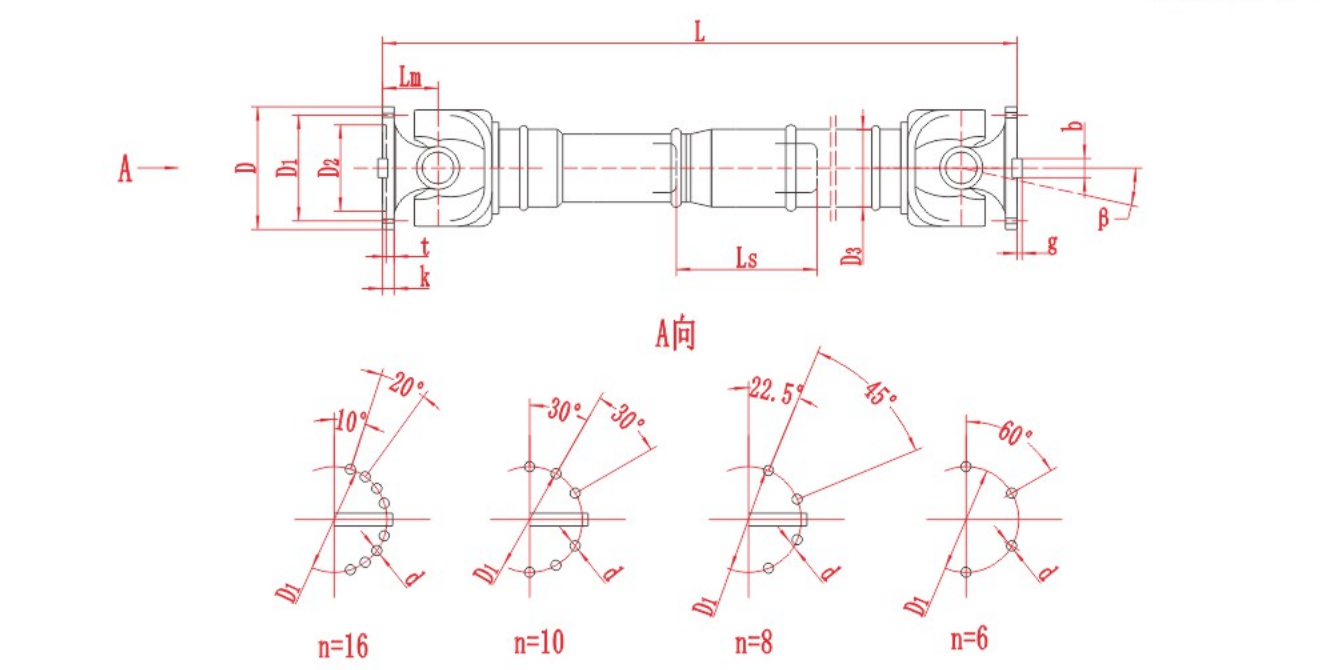
Figure 1. SWC-BH Telescopic Welded Cardan Shaft. The drawing identifies the length-compensation section marked Ls. Read the symbols with the matching model table; the lower flange-hole diagrams do not state permissible operating angles.
For example, RONGXING DRIVE SWC-BH is a telescopic welded configuration for comparison where an operating angle and length compensation are required. The series designation does not confirm a particular size or operating combination.
2. Separate roll-change movement from production movement
A mill may need little or no length variation during production but still need axial adjustment to connect or disconnect a roll-end interface. A telescopic assembly may help, provided the actual roll-change method uses that movement and the proposed shaft permits it.
Document the procedure as separate stages:
Normal connected production position.
Connected stopped position before disconnection.
Supported or disconnected position used to release the interface.
Removal, replacement and reconnection route.
State which connection is released, how the shaft is supported, the required shortening or withdrawal distance, and the available lifting and tool space. Do not assume that a shaft can hang unsupported, slide through its full catalogue travel under load, or separate safely just because it is telescopic.
If a fixed-length assembly can be installed and removed using an approved alternative arrangement, frequent roll changes alone do not prove that a telescopic replacement is necessary. Compare the complete maintenance procedure as well as the shaft drawing.
3. Consider thermal movement through the whole drivetrain
For a hot-mill installation, identify the temperatures, equipment supports and relative movement that affect the connection distance. Thermal growth somewhere in the machine does not establish how much movement reaches the cardan shaft or in which direction.
Where the resulting movement must occur in the shaft, include it in the required operating range. Where an approved arrangement accommodates that movement elsewhere, explain that arrangement when assessing a fixed-length candidate.
Ask the shaft supplier and mill engineer to review the sliding conditions and axial-force path. A length-compensation feature is not, by itself, proof that the assembly will isolate shock loads or eliminate thrust on connected equipment. Do not select it on an unverified bearing-protection promise.
4. Use fixed-length when the geometry and handling method support it
A fixed-length cardan shaft can be considered when the connection distance remains within the agreed operating conditions and the system provides any movement needed outside that assembly. Confirm this across the operating range, not just at the stationary position where the old shaft was measured.
The RONGXING DRIVE SWC-WF Non-Telescopic Flanged Cardan Shaft provides a non-telescopic configuration for this comparison. Its product record still includes joint-angle and torque fields: fixed length does not remove the need to check angular operation.
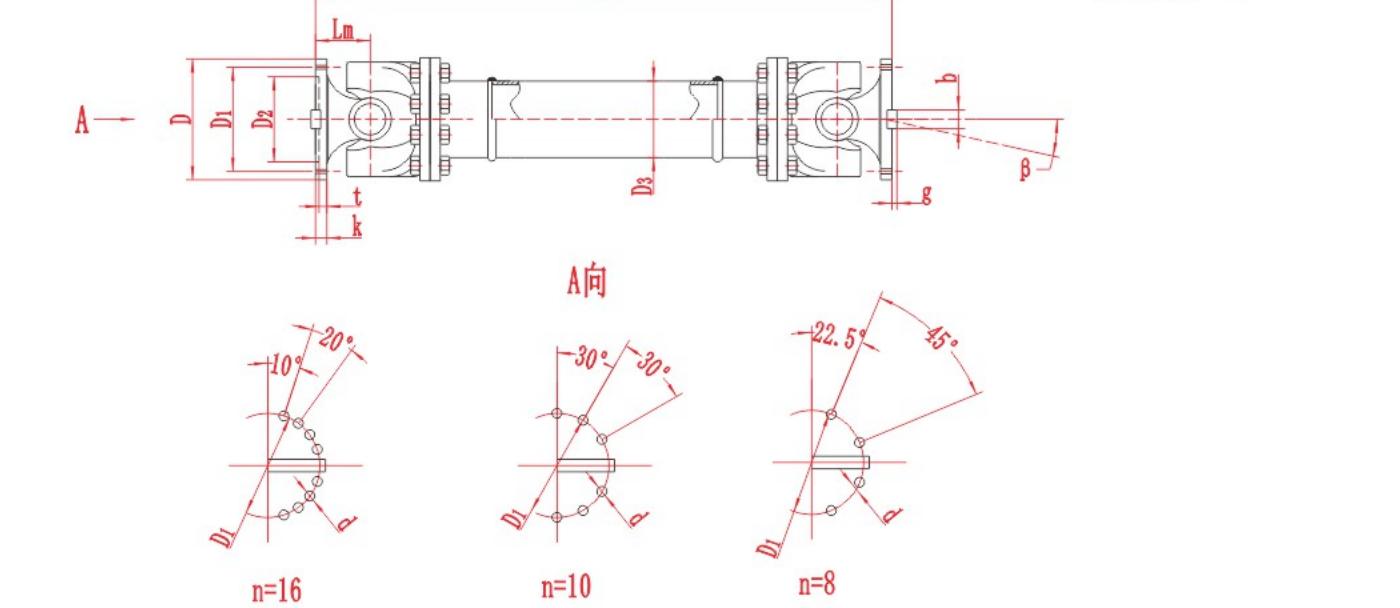
Figure 2. SWC-WF Non-Telescopic Flanged Cardan Shaft configuration. Use the complete approved dimensional drawing to specify installed length and connections. The flange-hole patterns below the assembly are connection details, not operating-angle limits.
Do not assume that fixed-length construction automatically provides a longer life, lower total cost or greater torque capacity. Compare actual candidate assemblies and the site’s inspection, lubrication and replacement requirements. Removing a sliding section does not remove the universal-joint bearings or their servicing needs.
5. Specify the required movement in both directions
For a telescopic candidate, provide the normal connection distance and its minimum and maximum working values, measured between identified reference planes. Keep these installation measurements separate from the supplier’s definitions of compressed length, catalogue length compensation and permitted extension.
A hypothetical mill-layout example
Assume the following connection distances use the same reference planes:
| Position | Assumed connection distance | What the figure means |
|---|---|---|
| Normal production | 1,200 mm | Intended working position for the enquiry |
| Shortest connected working position | 1,185 mm | 15 mm shorter than normal |
| Longest connected working position | 1,230 mm | 30 mm longer than normal |
| Disconnected roll-change position | To be confirmed | A separate handling requirement, not an assumed working limit |
The connected working-distance variation is 45 mm, but the requirement is asymmetric: 15 mm towards shortening and 30 mm towards extension from normal. These are hypothetical installation measurements, not permissible limits for a RONGXING DRIVE model.
A catalogue travel value of 45 mm would not, on its own, prove suitability. The supplier must also confirm the installed position, minimum engagement, end clearances, tolerance effects and any additional movement used during assembly or removal. Do not centre the shaft automatically or add a universal percentage allowance without an agreed basis.
Never force a telescopic section to its mechanical stops to establish a working range. Measurements and handling should follow the plant’s isolation procedures and the instructions for the assembly.
6. Check load, speed, interfaces and maintenance before choosing
The movement requirement narrows the structural choice; it does not complete the selection. For either arrangement, provide:
Normal, peak and repeated torque, with starting, braking and reversing duty.
Minimum, normal and maximum speed at the actual cardan shaft.
Both joint angles and how they change with equipment position.
Both mating drawings, including locating fits, bolt pattern and torque-transfer features.
Working length, rotating clearance, guards and support or removal arrangements.
Temperature, scale, water exposure, lubrication and inspection access.
Check speed, length and angle as a combination. A catalogue maximum angle or torque should not be treated as permissible at every other listed extreme. Rated torque and fatigue torque are separate rating fields, and neither is simply the buyer’s transient peak load.
For a steel mill in India, base the environmental requirements on the actual plant rather than the country name. If scale or spray makes the sliding section difficult to protect and service, discuss that constraint during selection. Choosing fixed length merely to avoid maintenance is unsuitable if the system still needs length compensation and has no approved way to provide it elsewhere.
Prepare the comparison for your mill
Send RONGXING DRIVE a dimensioned layout and a short explanation of the movement: during production, during stopped adjustment, during roll change, or in more than one of these conditions. Include the operating positions, torque/speed/angle data, both connection drawings, maintenance access and any previous failure history. State the quantity, destination in India and planned shutdown date.
Request a preliminary technical comparison of telescopic and non-telescopic candidates. Identify any unmeasured distances or unknown loads. Final construction, model size and suitability require confirmation against the complete duty and approved drawings.
Use the cardan shaft quotation data checklist to organise the input data. For the wider stand-selection process, see the rolling-mill cardan shaft selection guide for India.
Frequently asked questions
Does every rolling mill need a telescopic cardan shaft?
No. The requirement follows the connected geometry and the installation or roll-change procedure. A fixed-length assembly can be considered where the working distance is controlled and any necessary movement is handled elsewhere in an approved arrangement.
Can a fixed-length cardan shaft work at an angle?
Yes. A non-telescopic cardan shaft still has universal joints. Confirm each joint’s angle, phasing, speed and load against the proposed assembly; fixed length does not mean a rigid coupling.
Is telescopic construction required if movement occurs only during roll changes?
It depends on the removal method. Confirm whether the shaft must shorten while connected or supported, or whether another approved disconnection arrangement provides access. Maintenance movement should be assessed separately from loaded operation.
Can I replace a telescopic shaft with a fixed-length shaft of the same normal length?
Not from that measurement alone. First establish why length compensation was provided, how the distance varies in operation and how the assembly is installed or removed. Matching one length does not establish interchangeability.